Originaire de Lorient, en Bretagne, Tristan Le Govic commence la harpe celtique à six ans au Conservatoire de Musique Traditionnelle de Soye (Plœmeur). Docteur en musicologie, médaille d'or de harpe celtique et titulaire du Diplôme d'État de professeur de musique, il a consacré sa thèse à l'œuvre de la harpiste Kristen Noguès.
Porté par une énergie tout en finesse, son style se distingue par un sens du rythme affirmé et une grande richesse harmonique. Chanteur, conteur, musicien virtuose, il fonde son répertoire à la fois dans la tradition et autour de ses propres compositions.
En 2011, la harpiste Corrina Hewat l'invite à participer à son œuvre The Song of the Oak and The Ivy pour le 30e anniversaire du Festival International de Harpe d'Édimbourg, aux côtés de Mary Macmaster, Wendy Stewart, Heather Downie et Bill Taylor. Reprise plusieurs fois pas la suite, la pièce sera finalement enregistrée dix ans plus tard sur l'album homonyme.
I had always been inspired by my travels to Brittany, playing in festivals like Lorient, Quimper, Dinan, St Malo. I realized I wanted to bring that light yet heavy Fest Noz dance groove into our music, a characteristic Tristan captures beautifully on his electroacoustic harp.
Corrina Hewat
La diversité de son répertoire se reflète dans ses nombreuses rencontres musicales notamment avec le contrebassiste écossais Stuart Macpherson, le percussionniste anglais Roy Shearer ou encore la chanteuse suédoise Lise Enochsson avec qui il a développé un répertoire unique de musique scandinave à la harpe celtique (CD Elva). Avec le contrebassiste Tangi Le Hénanff et le batteur Alan Quéré-Moysan, il a formé le Tristan Le Govic Trio, trio récompensé par le prix Nevez Flamm - élu meilleur groupe de Fest Noz 2018 - et avec lequel il a sorti l’album Dañs.
Après Diriaou, un spectacle autour du répertoire de Kristen Noguès avec le Collectif ARP sous la direction de Jacques Pellen, il poursuit la redécouverte de cette œuvre en quartet avec Manon Albert (voix), Cédrick Alexandre (contrebasse et basse) et Patrick Boileau (batterie).
Éditeur de L'Antologiezh Telenn Breizh - une anthologie de partitions pour harpe celtique en trois volumes réunissant les plus grands harpistes de Bretagne (Alan Stivell, Kristen Noguès...) - il a également publié de nombreux autres recueils pour son instrument et participé à des ouvrages sur la harpe celtique.
Interview en breton 
Concerts, stages, conférences
Festivals
Harp on Wight · Fest ar laridenn · Diwanarzik · Interkeltisches Folkfestival · Island Mountain Arts · 1000 Strings Festival · Edinburgh International Harp Festival · Festival Camac · Fête du Thé du Blavet · Victoires de la Bretagne · Celtic Harp International Academy · Rencontres Internationales de Harpe Celtique · L'Échappée · Harpes au max · Festival de Harpe en Avesnois · Festival de Harpe de Gargilesse · NoBorder · Noia Harp Fest · Gorsedd digor · Bro Alré Gouil Bamdé · Yaouank · Presqu'Île Breizh · Somerset Folk Harp Festival · Festival des Chapelles d'Erdeven · Harfentreffen · Taol Kurun · Kan ar bobl · Atlantique Jazz Festival · Zik ZH · Harpes à Douarn · Jartdin · World Harp Traditions International Conference · Couleurs du Monde · An Arwenn · Nevez Flamm · Mil Tamm · Voix de Bretagne · Journées Européennes du Patrimoine · Festival Interceltique · Musiciennes à Ouessant · Harpes Aventures · Camac · Cwlwm Celtaidd · Festival Harpes en Loire · Harp Village · Fest'Yves · International Harp Friends Meeting · Rencontres du Cinéma Européen · Scènes de Jardins · L'Affaire est dans l'Sax · Arfavita · Nordic Harp Meeting · Celtic Connections · Fringe Festival · Ceòl’s Craic · Moniaive Folk Festival · Insubria · Leith Folk Club · Öresunds HarpHelg · Peebles Arts Festival · Festival Euro-choeurs · Merchant City Festival · Festival Les Médiévales · Deizioù
Visuels
Revue de presse
Breton Brilliance
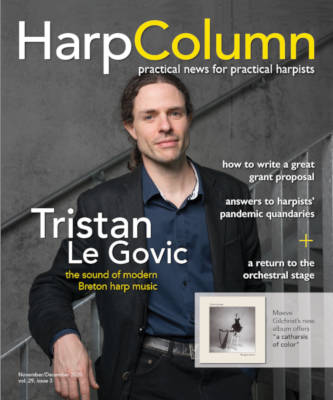
Harp Column: What makes Breton music special for you?
Tristan Le Govic: It’s the music where I come from. It’s my roots. I’m the second generation after the big Celtic growth of the Celtic harp, which happened with Alan Stivell, of course. He was the first to play traditional Breton Celtic music on the harp, and I am part of the generation which came after that. When I grew up, there was a huge Celtic revival, thanks to Alan Stivell, and in particular, a huge concert he did in 1972 at the Olympia Concert hall in Paris. That started a huge wave of Celtic music all over the world. For the first time, you could see the Celtic harp on stage with the electric guitar, with a rock attitude on the stage, which was very popular at that time. I was born in 1976, four years later, so I didn’t see that concert, but I was part of the wave that followed that concert. Without Stivell, I probably would not be here. He made the music popular, he made the Breton language more popular, and of course he made the Celtic harp more popular. He presented something that was completely new to people, so when I came along it was a bit easier for me because people knew this music already. I came to the harp in 1982, 10 years after this revival, and by then the Celtic harp wasn’t such a new thing. There were enough Celtic harpists around me that I was sure I wanted to be one too. Playing traditional music still wasn’t so easy at that time, despite Alan Stivell. There were no structures to learn Celtic harp at that time like we have now, of course. I was very lucky in my hometown there was a school—it was a unique place because it was a private conservatory only for traditional music. It didn’t last for a long time, unfortunately, but I’m part of this generation that started only with traditional music. It was great. It was as normal for me to go in and learn traditional music as it would have been to learn Mozart or Bach. I used to go to the fest-noz. I grew up with those pictures and images and sounds in my ears. I was able to see harps on exhibition at the biggest folk music festival in the world, Festival Interceltique, which happens to be held in my hometown of Lorient in Brittany. There were thousands of people coming to the festival from around the world every summer, except this year of course. I remember when I was young, I lived in a part of the city where there was a campsite where musicians who were invited to perform would come and stay a week before the festival and practice together. So I would hear this music and these sounds—I was surrounded by that and fascinated by that as a child. So for me, Breton music was not something new. I heard it all around me.
[…]
Eh bien, il a pu assister à un excellent moment de musique mêlant mélodies et airs de toutes les régions de la Celtie : jigs irlandaises, plinn breton, marche écossaise, airs tsiganes du pays de Galles, ballade asturienne, scottish norvégienne pas très celtique mais tellement bien interprétée par Tristan. Le dialogue entre Rachel et Tristan, appuyé sur une pseudo-rivalité entre l’Écosse et la Bretagne, contribue à créer cette atmosphère de complicité qui enchante le public. Eh oui, la gavotte et le reel sont très proches et peuvent mêler leurs accords et leurs harmonies.
La puissance de la triple harpe, le jeu cristallin de Rachel, le groove de Tristan, contribuent dans les morceaux interprétés en commun à cette couleur unique des instants magiques du Festival. La Kesh jig, si souvent entendue, prend alors une dimension inespérée dans le dernier rappel et vient conclure en apothéose ce grand moment trop vite passé.
Residents, and the masses of visitors, were extraordinarily lucky with the first act. The harp is a classic instrument in the traditional music repertoire, and just beginning a revival here, although we are told it is massively popular on the mainland of Europe.. However it is quite rare in the UK to see it as a solo instrument, or in a duo of unaccompanied harpists.
The moment Tristan Le Govic (top picture) and Ailie Robertson plucked their first notes, it was clear that the audience were in for something special. They quickly established a relaxed and appreciative atmosphere in the audience. With Tristan’s virtuosity on the Breton harp, combined with appealing stories and song in Breton and French, it is no surprise that he is in demand at Festivals, has composed music for the cinema, and has won major competitions internationally.
Ailie is also no stranger to competition. No clarsach player has ever won the BBC Young Traditional Musician of the Year Award, but she was a rare clarsach finalist. Picking up five Mod gold medals along the way of her short career, she shows just how versatile the instrument can be. Her warmth, touch and subtlety shine through on stage. This duo made a wonderful exploration of the music of two different, but interlinked, cultures, creating a rich tapestry of traditional tunes, woven with new compositions. Their performance delighted everyone present.
Tout semble si simple, si tranquille avec lui. Il nous ballade de la région de Baud, en passant par les pêcheurs de Paimpol, puis l'Irlande. Quand il traduit le dur métier des pêcheurs d'Islande avec sa harpe, c'est comme si on entendait simultanément sonner le glas pour les marins qui se noient, tressaillir le bateau secoué par la tempête, et les cris des pêcheurs qui luttent avec acharnement.
Tristan Le Govic chante ou joue de la harpe, comme il respire, avec aisance, sans artifice, faisant naître de son doigté ou de sa voix de subtiles émotions et une limpide poésie".
La harpe enchantée de Tristan Le Govic
Tout en quittant la forêt, le harpiste pense : " Lorsque je reviendrai sur Terre, je ne resterai pas à rêver." Mais peut-on s'empêcher de rêver lorsqu'on est musicien ? Certes non ! On le retrouve quelques instants plus tard à Paimpol, s'embarquant, avec les marins pêcheurs, pour la mer d'Islande. Témoin de leurs mésaventures, il les chante. Sa voix se perd bientôt dans les brumes, déchaînant aussitôt le rire moqueur des mouettes. Pourtant, quelques gavottes plus loin, Tristan Le Govic trouve refuge dans son pays, tenant la main d'une jeune fille. "Venez avec moi ; jeune fille, venez au jardin. Vous y verrez des roses blanches."
Lothéa : Tristan Le Govic envoûte la petite chapelle
Pureté. Dès les premières notes, le public est envoûté par tant de pureté. Entre compositions personnelles, laridés, gwerzioù, Tristan Le Govic sait distiller les émotions. Dans le cadre de la petite chapelle, les sons s'envolent, vibrent et touchent le spectateur en plein coeur. Entre chaque morceau, le virtuose explique en toute simplicité, en breton puis en français, les morceaux interprétés, les arrangements choisis.
Sonorités cristallines. La harpe celtique accompagne à merveille sa voix profonde de sonorités cristallines. Ses chants sont tour à tour tristes et gais. C'est une invitation à un voyage dans le temps que propose Tristan Le Govic. Pour autant, ses interprétations n'en oublient pas une étonnante modernité. Preuve que passé et présent se conjuguent.